
Cloud hosting vs shared hosting is one of the most common comparisons you will encounter when choosing where to host your website in 2026. The framing is slightly imprecise — cloud hosting is technically a type of hosting — but what people typically mean is: should I use traditional shared or VPS hosting, or should I move to cloud infrastructure?
The answer depends on your site’s traffic, budget, and performance requirements. This guide gives you the honest comparison between cloud hosting vs shared hosting so you can make the right decision.
Understanding the Terminology
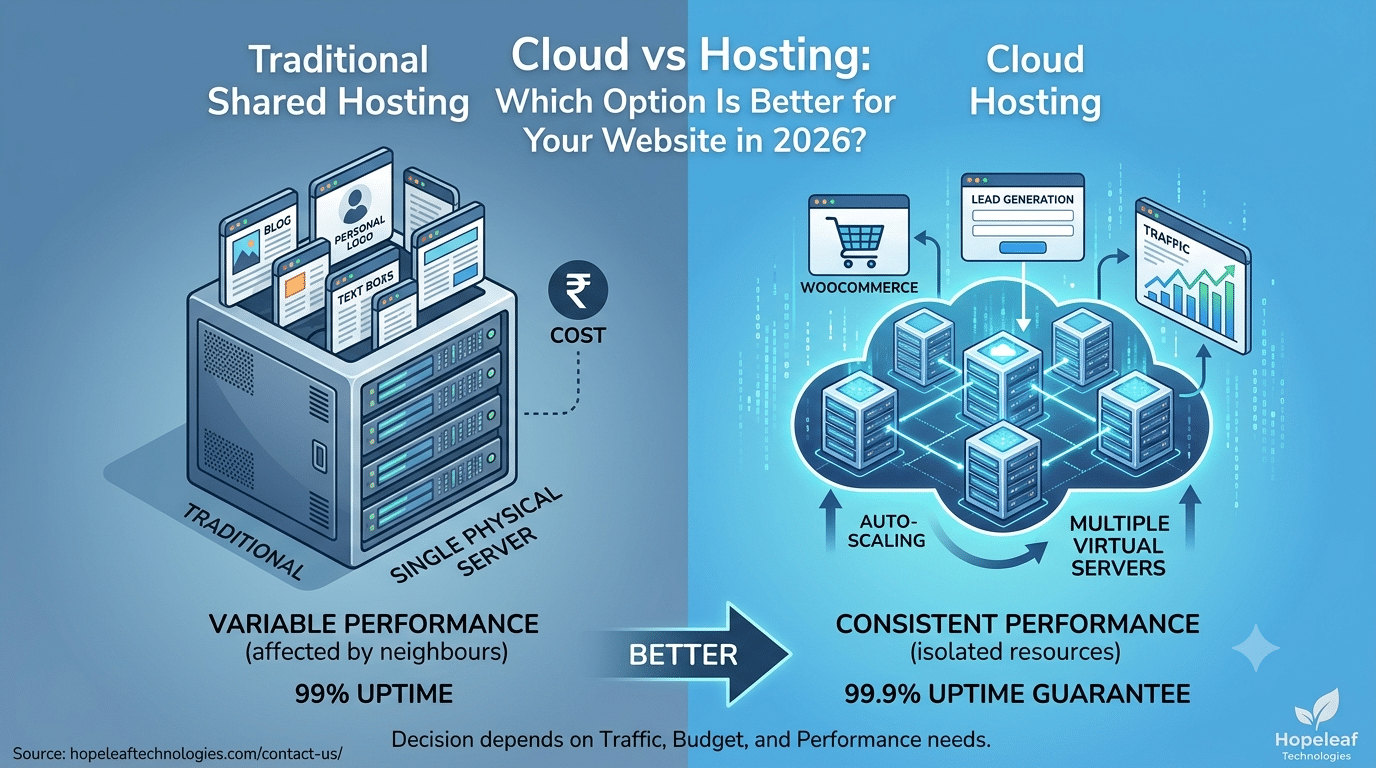
Traditional shared hosting puts your site on a single physical server alongside hundreds of other websites — all competing for the same CPU, RAM, and bandwidth. Cloud hosting distributes your site across multiple virtual servers with auto-scaling, redundancy, and CDN capabilities built in.
According to Bluehost’s 2026 hosting comparison guide, the core difference between cloud hosting vs shared hosting comes down to one thing: shared hosting ties your performance to a single machine, while cloud hosting spreads it across many — eliminating the single point of failure entirely.
Cloud Hosting vs Shared Hosting: Head-to-Head Comparison
| Factor | Traditional Hosting | Cloud Hosting |
|---|---|---|
| Cost | ₹149–₹1,500/month (lower upfront) | ₹850–₹10,000/month |
| Performance | Variable — affected by neighbouring websites. | Consistent — isolated resources. |
| TTFB | 800ms–1,500ms typical. | 100–350ms typical. |
| Scalability | Manual upgrade required (downtime risk). | Auto-scales on demand. |
| Uptime | 99%–99.5% typical. | 99.9%–99.99% guaranteed. |
| Traffic spikes | Site slows down or crashes. | Handles traffic spikes automatically. |
| Setup difficulty | Minimal — plug and play. | Slightly more involved with additional configuration options. |
| Best for | Small blogs, starter websites, and low-budget projects. | Business websites, WooCommerce stores, and growing websites. |
5 Key Situations Where Cloud Hosting Wins Over Shared Hosting
1. You're Running a WooCommerce Store
When comparing cloud hosting vs shared hosting for WooCommerce, cloud hosting is the clear winner. Every minute your store is slow during checkout is lost revenue. Cloud hosting’s 99.9%+ uptime guarantee and auto-scaling during sale spikes directly protects that revenue. The cost difference between shared hosting (₹500/month) and cloud hosting (₹850/month) is trivial compared to the cost of a single hour of downtime on a live store.
2. You Run Paid Advertising
If you are sending Google Ads or Meta Ads traffic to your WordPress landing pages, cloud hosting vs shared hosting is not even a close call. Every visitor who bounces due to a slow or unresponsive shared hosting page is wasted ad spend. Cloud hosting’s faster TTFB and consistent performance under load directly improves your cost per conversion.
3. Your Site Has International Visitors
Cloud hosting with CDN integration delivers content from servers geographically close to each visitor. A Melbourne-based visitor to your Surat-hosted site loads content from a Sydney or Singapore CDN node rather than waiting for data to travel across two oceans. This can reduce load times for international visitors by 40–60% — something shared hosting simply cannot replicate.
4. You Are Past 10,000 Monthly Visitors
At this traffic volume, resource contention on shared hosting typically begins degrading performance. Cloud hosting handles 10,000 monthly visitors as easily as 100,000 — it simply allocates more resources as needed, with no manual intervention required.
5. Your Site Generates Leads or Revenue
Any business website that generates leads, bookings, or sales needs the reliability that cloud hosting provides. In the cloud hosting vs shared hosting debate, shared hosting is adequate for hobby sites — for revenue-generating sites, cloud hosting is a performance requirement, not a luxury.
When Shared Hosting Is Perfectly Fine
- A personal blog with under 5,000 monthly visitors and no revenue-generating purpose
- A starter or placeholder site while you build a larger project
- A development or staging environment that does not need production performance
Cloud Hosting vs Shared Hosting: The Verdict for 2026
- The global cloud hosting market is growing at a CAGR of 23.6% — because businesses have discovered that the performance gains from cloud infrastructure deliver measurable business results. In 2026, for any business website that matters to your revenue, cloud hosting is the sensible default over shared hosting.
We Build Every Business WordPress Site on Cloud Hosting
Hopeleaf Technologies recommends and configures cloud hosting for all client business websites. Whether it’s Cloudways, SiteGround GoGeek, or Kinsta — we choose the right provider for your budget and traffic.
- Start with the right hosting → hopeleaftechnologies.com/contact-us/
We Build Every Site in Elementor Pro
Hopeleaf Technologies is a specialist Elementor agency — we design in Figma and build in Elementor Pro on WordPress. Fast, editable, and built to rank on Google.