
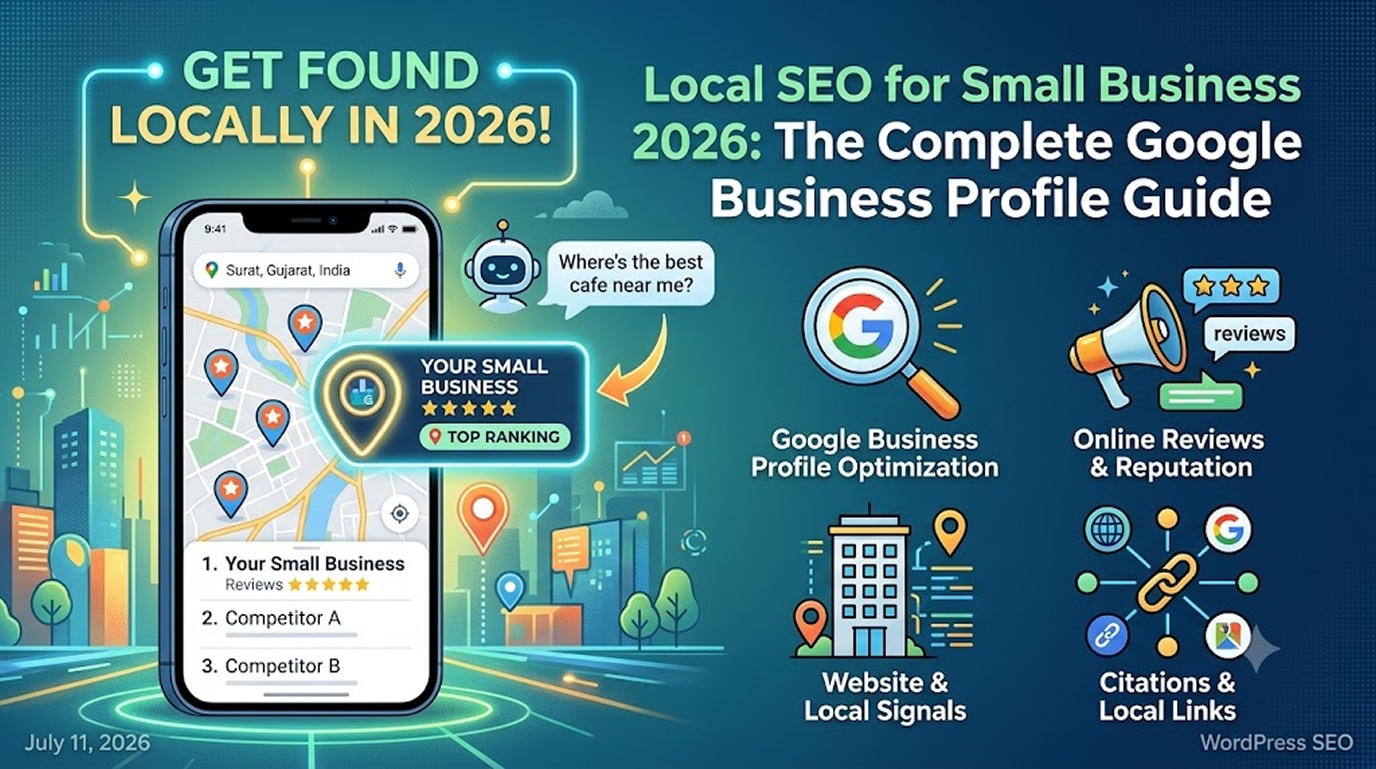
Local SEO for small business starts with a simple truth: when someone nearby searches “dentist near me” or “best café in [your city],” Google shows a map with three businesses before anything else. Landing in that map pack — and in the AI-generated local answers increasingly shown alongside it — is the highest-value real estate a local business can occupy, and it’s won through the discipline of local SEO for small business owners can genuinely learn to run themselves.
The good news: local SEO rewards consistent basics over budgets. Here’s the complete 2026 playbook.
How Local SEO for Small Business Rankings Actually Work
Google ranks local businesses on three factors, as Google’s own Business Profile help documentation explains:
- Relevance — how well your profile and website match what was searched
- Distance — proximity to the searcher (you can’t change this; you can win the searches you’re eligible for)
- Prominence — how established you look: reviews, mentions across the web, website authority
Everything below strengthens relevance and prominence. And in 2026 there’s a fourth audience: AI assistants answering “where should I get X near me?” draw on the same signals — profiles, reviews, and structured website content — so this local SEO for small business work pays twice.
Step 1: Google Business Profile — The Foundation of Local SEO for Small Business
Your Google Business Profile (GBP) is the free listing powering your map presence. Most businesses claim it and stop; optimising it is where rankings come from.
- Complete every field. Exact business name (no keyword stuffing — it violates guidelines), address, phone, hours, website, attributes. Profiles with complete information rank measurably better.
- Choose categories precisely. Your primary category is the strongest relevance signal you control — be specific (“Wedding Photographer,” not “Photographer”), then add relevant secondary categories.
- Write a genuine description covering what you do, who you serve, and your area — naturally, not as a keyword list.
- Add real photos monthly. Storefront, team, work examples. Profiles with fresh photos get significantly more calls and direction requests; stock photos are a trust killer.
- Use Products/Services sections with descriptions and prices where possible — these appear directly in your profile and feed AI answers.
- Post updates (offers, news) a few times a month. Activity signals a living business.
- Enable messaging and Q&A — and answer. Pro tip: you can seed the Q&A section yourself with your most-asked questions and their answers.
Step 2: Turn Reviews Into a Local SEO for Small Business System
Reviews are among the strongest local ranking factors — and the deciding factor for humans choosing between the three map results.
- Ask every happy customer at the moment of satisfaction, with a direct review link (GBP gives you a short URL; put it in follow-up emails, invoices, and a QR code at the counter).
- Aim for steady flow, not bursts. Five reviews a month for a year beats sixty in one week (which looks suspicious to both Google and customers).
- Reply to every review — warmly to praise, professionally to criticism. Responses are public proof of how you treat customers, and owner engagement is a ranking signal.
- Never buy or fake reviews. Detection is aggressive and penalties include review removal and suspension.
Step 3: Build Local Signals on Your Website
Your GBP and website reinforce each other; weak websites cap map rankings — which is why local SEO for small business owners has to include the website, not just the profile.
- A dedicated page per location/service area with unique, genuinely local content — the areas you serve, local landmarks, location-specific testimonials and photos. Ten thin “SEO pages” with swapped city names get filtered; three substantial ones rank.
- NAP consistency: your Name, Address, Phone must be identical everywhere — website footer, GBP, directories. Inconsistency erodes Google’s confidence in your data.
- LocalBusiness schema markup per Schema.org’s official LocalBusiness specification, tells Google (and AI assistants) your exact details in machine-readable form — a standard part of every site we build.
- Embed your Google map on the contact page, and make phone numbers tap-to-call — most local searches happen on phones.
- Publish locally useful content: “how to choose a [your service] in [city],” pricing guides, project showcases. This is what earns rankings beyond the map pack — and citations in AI answers (see our AEO guide).
Step 4: Citations and Local Links for Local SEO for Small Business
Citations — mentions of your NAP on directories like Justdial, Sulekha, IndiaMART (or Yelp and industry directories abroad) — establish prominence. Cover the major general and industry-specific directories with perfectly consistent details, then stop; fifty spammy directories help nobody.
Local links are stronger still: the chamber of commerce, local news coverage, community sponsorships, supplier partnerships. One genuine local newspaper link outweighs dozens of directory entries.
Step 5: Track What Matters
- GBP performance reports: searches you appeared for, calls, direction requests, website clicks — trend these monthly
- Search Console: rankings and clicks for “[service] + [city]” queries
- Ask new customers how they found you — still the most honest attribution tool a small business has Expect visible movement in 4–8 weeks and strong results in 3–6 months; local SEO compounds.
Frequently Asked Questions
How long does local SEO take to work?
Profile optimisation shows effects within weeks; reviews, content, and citations compound over 3–6 months. It’s a rhythm, not a one-time fix.
I serve customers at their location and don't want my address public. Can I still rank?
Yes — GBP supports service-area businesses: hide the address, define your service areas, and the rest of this playbook applies unchanged.
Why does a competitor with worse reviews outrank me?
Usually stronger relevance signals (better categories, more complete profile, stronger website content) or prominence (citations, links, engagement). Rankings weigh the whole picture, not review stars alone.
Do I need to pay for Google ads to appear in the map pack?
No. Ads can appear above the map pack, but the pack itself is organic — earned exactly as described here.
Want Your Local SEO for Small Business to Land in the Map Pack — and in AI Answers?
We build local SEO (schema, location pages, GBP optimisation) into every WordPress site we launch.
- Book a Free Local Visibility Check → hopeleaftechnologies.com/contact-us/
We Build Every Site in Elementor Pro
Hopeleaf Technologies is a specialist Elementor agency — we design in Figma and build in Elementor Pro on WordPress. Fast, editable, and built to rank on Google.