
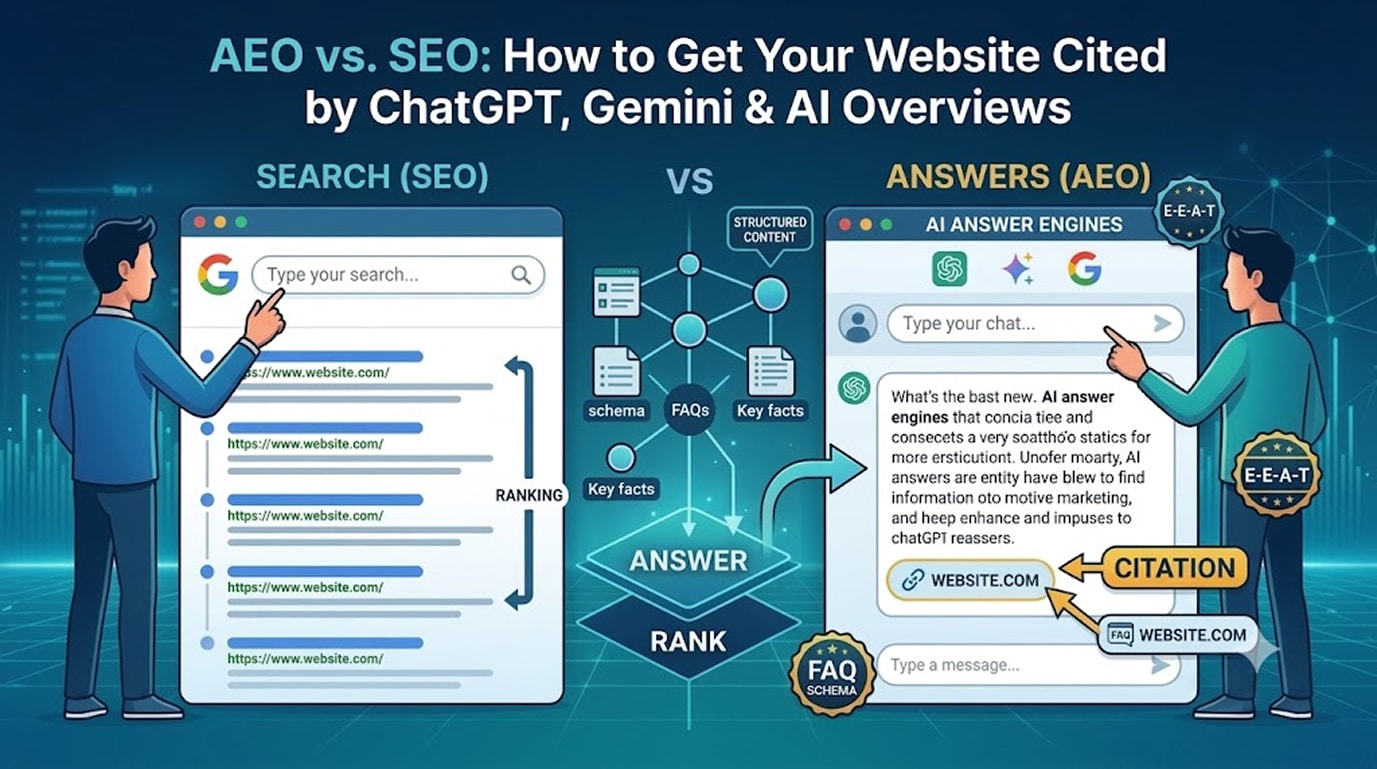
For twenty years, being found online meant one thing: ranking on Google. In 2026, a growing share of your potential customers never see a traditional results page at all. They ask ChatGPT for a recommendation, read Google’s AI Overview at the top of the page, or let Gemini summarise their options — and the websites those AI systems cite win the customer.
This is where AEO comes in. Here’s what it is, how it differs from SEO, and exactly how to make your website the one AI engines quote.
What Is AEO?
AEO (Answer Engine Optimization) — sometimes called GEO, Generative Engine Optimization — is the practice of structuring your website so AI systems can easily understand, extract, and cite your content when answering user questions. Google’s own guidance on AI features in Search confirms that structured, clearly-answered content is favoured by its AI-generated overviews — the same principle AEO is built around.
Traditional SEO earns you a ranking position. AEO earns you a citation inside an AI-generated answer. Both send traffic; increasingly, the citation sends the more qualified visitor, because they arrive pre-sold by the AI’s recommendation.
AEO vs SEO: What Actually Changes
The good news: AEO is not a replacement for SEO. Sites that rank well are far more likely to be cited by AI engines, because most AI search systems retrieve from conventional search indexes. Think of AEO as SEO plus a layer of answer-friendly structure.
| Factor | Traditional SEO | AEO |
|---|---|---|
| Goal | Rank in the top 10 | Be quoted in the AI answer |
| Content style | Comprehensive pages | Direct answers + depth |
| Key structure | Keywords, headings, links | Q&A blocks, schema, extractable facts |
| Measured by | Rankings, organic clicks | AI citations, referral traffic from AI tools |
7 Tactics That Get Your Site Cited by AI
1. Answer the question in the first two sentences
AI engines extract concise, self-contained answers. Open every important section with a direct answer, then expand. If your “how much does a website cost” page takes 400 words to reach a number, an AI will cite a competitor who answered in 40.
2. Use real question-based headings
Structure H2s and H3s as the questions people actually ask: “How long does a website take to build?” rather than “Project timelines.” These map directly onto the prompts users type into AI tools.
3. Add FAQ and structured schema markup
Schema markup (FAQPage, HowTo, Article, Organization, Service) is machine-readable labelling that tells AI systems exactly what your content means. Schema.org’s official documentation defines the FAQPage type used for this purpose. On WordPress, plugins like RankMath make this straightforward — but the schema must match genuinely useful on-page content.
4. Include extractable facts, numbers, and tables
AI answers love specifics: price ranges, timelines, comparison tables, step counts. Vague content (“costs vary depending on your needs”) is uncitable. Specific content (“a small business WordPress site typically costs ₹50,000–₹1,50,000”) gets quoted.
5. Demonstrate first-hand experience
AI systems, like Google, increasingly favour content showing real experience: case studies, original screenshots, client results, named authors with credentials. This aligns with Google’s E-E-A-T guidance on experience, expertise, authoritativeness, and trust. A post signed by a real specialist beats an anonymous one.
6. Keep content fresh and dated
AI engines prefer current sources. Update key pages regularly, show a visible “last updated” date, and refresh statistics annually.
7. Build the same authority signals as SEO
Citations follow authority. Reviews, backlinks, consistent business information, and an established domain all raise the odds that an AI treats your site as a trustworthy source.
How to Measure AEO Results
Check your analytics for referral traffic from chatgpt.com, perplexity.ai, gemini.google.com and similar sources — most analytics tools now separate these. Then periodically ask the major AI tools your customers’ questions (“best WordPress agency for small business websites”) and note whether you’re cited. Treat it like rank tracking for the AI era. Our SEO and content services build this structure into every WordPress project from the start.
Frequently Asked Questions
Is AEO worth it for small businesses?
Yes — arguably more than for big brands. AI answers frequently cite specific, well-structured small sites over generic corporate pages, because the small site answered the question better.
Does AEO replace SEO?
No. AI engines mostly retrieve from search indexes, so strong SEO is the foundation. AEO is the structure layer on top.
How long does it take to see AI citations?
Typically 2–4 months after implementing structured, answer-first content — faster if your domain already ranks for related terms.
What's the single highest-impact change?
Adding a genuine FAQ section with FAQ Page schema to your key service pages. It’s the most directly extractable format for both AI Overviews and chat assistants.
Want your website cited by AI search engines, not just ranked?
Our SEO service builds schema, answer-first structure, and Core Web Vitals into every page.
- Ask about WordPress hosting t → hopeleaftechnologies.com/contact-us/
We Build Every Site in Elementor Pro
Hopeleaf Technologies is a specialist Elementor agency — we design in Figma and build in Elementor Pro on WordPress. Fast, editable, and built to rank on Google.