
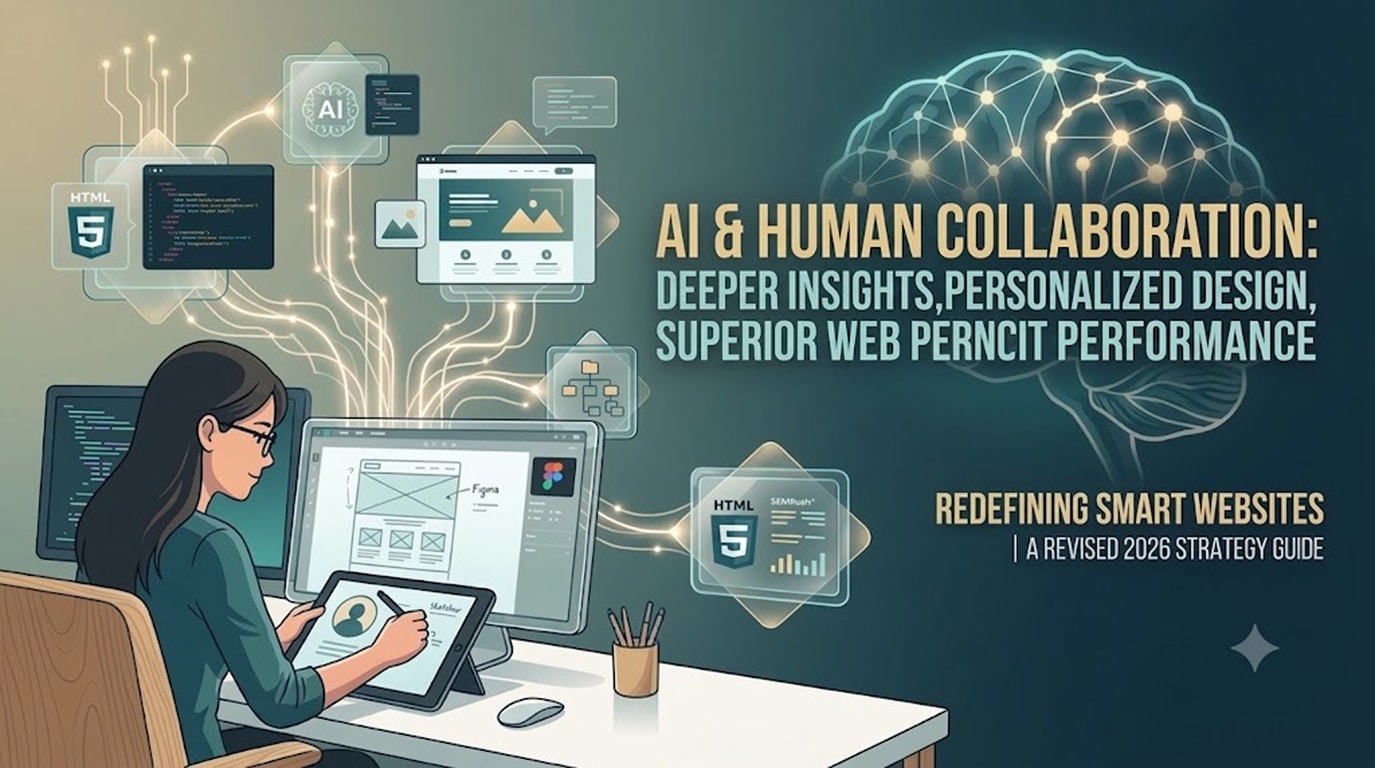
AI has moved from a novelty to a normal part of how websites get built. Developers use AI assistants to write and review code, designers use AI to generate layout variations, and business owners are bombarded with ads for “build your website in 60 seconds” AI tools. So what does AI in web development actually mean for your business in 2026 — and where does it genuinely help versus where does it fall short?
This guide cuts through the hype with a practical look at what AI in web development can do for your website today.
How AI in Web Development Is Actually Used in 2026
Professional agencies and developers use AI in web development across the entire workflow, not as a replacement for it:
AI-Assisted Coding
The majority of professional developers now use AI coding assistants daily. According to GitHub’s own research, developers complete tasks significantly faster with AI-assisted coding tools, saving multiple hours per week. These tools suggest code, catch bugs, and speed up repetitive work. The result for you as a client: projects move faster and budgets stretch further, because developers spend less time on boilerplate and more time on the parts that need human judgement.
AI in Website Design
Designers use AI to generate layout concepts, colour palette options, and placeholder imagery during the wireframe stage. At Hopeleaf, our Figma-first process benefits from this application of AI in web development: we can explore more design directions in the concept stage before a single Elementor widget is placed.
AI Content Assistance in Web Development
AI drafts product descriptions, meta descriptions, and first-pass page copy — which human writers then edit for accuracy, brand voice, and SEO. Publishing raw AI text without editing is a fast way to sound like every other website on the internet.
AI personalisation
Modern websites can adapt content based on visitor behaviour — showing different calls to action to returning visitors, or reordering products based on browsing history. This used to be enterprise-only; in 2026 it’s accessible to small businesses through WordPress plugins.
AI Website Builders vs a Professional Build: The Honest Comparison
The question we hear most: “Why should I pay an agency when an AI tool can build my site in a minute?”
Here’s the honest answer. AI website builders are genuinely impressive at producing a website. They are much weaker at producing your website — one that reflects your brand, converts your specific audience, ranks for your keywords, and can grow with your business. Recent industry analysis of AI in web development trends points to the same conclusion: AI accelerates production, but strategic and brand decisions still require human oversight.
| Factor | AI Website Builder | Professional WordPress Build |
|---|---|---|
| Speed to first draft | Minutes | 3–4 weeks |
| Design uniqueness | Template-like, generic | Custom Figma design |
| SEO foundation | Basic at best | Schema, Core Web Vitals, keyword strategy |
| Ownership | Locked to the platform | You own everything |
| Scalability | Limited | Unlimited (WooCommerce, custom features) |
| Ongoing cost | Monthly subscription forever | One-time build + optional maintenance |
AI builders are a reasonable choice for a hobby project or a temporary landing page. For a business website that needs to generate leads for years, the limitations show up quickly — usually in rankings, load speed, and the moment you need a feature the builder doesn’t offer.
Where AI Genuinely Improves Your Website
Whether you build with an agency or not, these applications of AI in web development are worth having in 2026:
- AI chatbots trained on your content answer customer questions 24/7 and capture leads while you sleep.
- AI-assisted search on larger sites helps visitors find products or articles using natural language.
- Smart image optimisation automatically compresses and converts images, improving Core Web Vitals scores.
- AI-readable structure — pages built with clear headings, FAQ schema, and structured data get cited by ChatGPT, Gemini, and Google AI Overviews, a growing traffic source.
That last point matters more than most business owners realise: AI search engines are now a real discovery channel, and websites structured for them win visibility their competitors miss. A broader look at AI and web development adoption shows this shift is accelerating industry-wide, not just at the enterprise level.
What AI Still Can't Do
- Understand your business strategy. AI doesn’t know that 80% of your revenue comes from one service, or that your best clients come from referrals who need reassurance, not hype.
- Make brand judgement calls. Typography, tone, photography style — the things that make a site feel trustworthy — still need human taste.
- Take responsibility. When a plugin update breaks your checkout at 2am, an AI builder’s support queue won’t fix it. A maintenance partner will.
How Hopeleaf Uses AI (and Where We Don't)
We use AI to work faster — code review, design exploration, content drafting — and we never use it to skip the thinking. Every site we ship is designed in Figma by a human, built in Elementor Pro by a specialist, and launched with SEO configured by someone who checked it manually. AI in web development makes our process faster; it doesn’t replace the process. You can see our full approach on our services page.
Frequently Asked Questions
Will AI replace web developers?
AI is changing what developers do — less boilerplate, more architecture and judgement — but businesses still need humans to translate goals into websites that convert. The developers using AI well are simply delivering more value per hour.
Are AI-built websites bad for SEO?
Not automatically, but most AI builders produce thin, generic content and bloated code that struggles with Core Web Vitals. Google also rewards experience and originality — hard to demonstrate with template output.
Should I add AI features to my existing WordPress site?
An AI chatbot and AI-ready content structure are the two highest-return additions for most small businesses. Both can be added to an existing WordPress site without a rebuild.
How much does an AI-enhanced website cost?
A professional WordPress build with AI chatbot integration and AI-optimised content structure typically adds ₹15,000–₹40,000 ($180–$480) to a standard project — far less than most owners expect.
Ready to Build a Website That Uses AI Where It Helps?
We’ve delivered 150+ WordPress sites for clients across four continents — using AI in web development where it earns its place, and human expertise everywhere else.
- Ask about WordPress hosting t → hopeleaftechnologies.com/contact-us/
We Build Every Site in Elementor Pro
Hopeleaf Technologies is a specialist Elementor agency — we design in Figma and build in Elementor Pro on WordPress. Fast, editable, and built to rank on Google.