
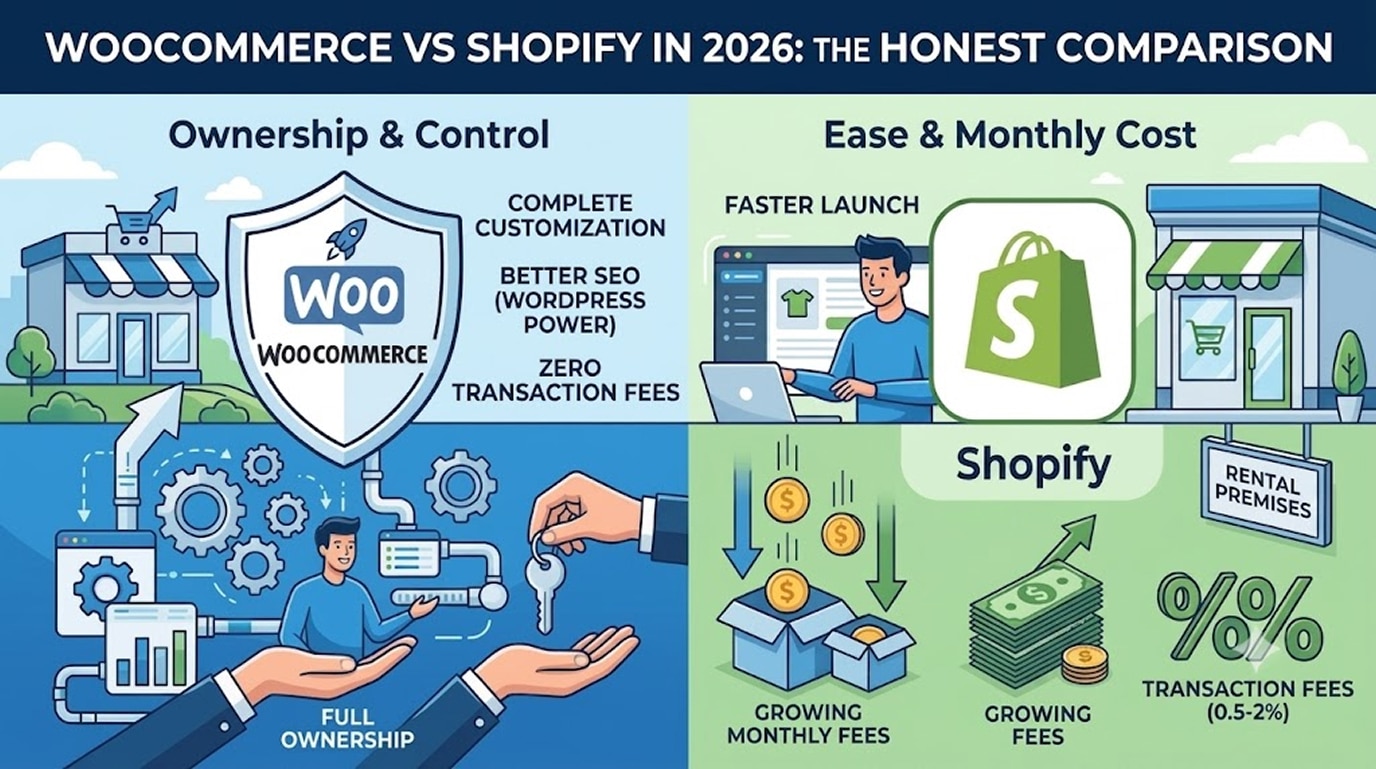
WooCommerce vs Shopify is one of the most consequential decisions a growing store makes in 2026. Both power the majority of the world’s online stores, and both can absolutely run a successful business. But they take opposite approaches — Shopify rents you a polished store; WooCommerce lets you own one — and the right choice depends on how you sell, how much you sell, and how much control you want.
We build WooCommerce stores for a living, so let’s be upfront about that bias — and then be genuinely fair, because Shopify is the right answer for some businesses.
WooCommerce vs Shopify : The Short Answer
- Choose Shopify if you want the fastest possible launch, are happy paying monthly forever, and your store fits standard e-commerce patterns.
- Choose WooCommerce if you want to own your store, avoid per-sale platform fees, need custom functionality, care deeply about SEO and content marketing, or already run WordPress.
WooCommerce vs Shopify: Head-to-Head Comparison
| Factor | WooCommerce | Shopify |
|---|---|---|
| Type | Free plugin on WordPress you own | Hosted subscription platform |
| Monthly platform fee | ₹0 (pay only hosting) | ~₹2,500–₹25,000+/month by plan |
| Extra transaction fees | None | 0.5–2% unless using Shopify Payments |
| Payment gateways | Any (Razorpay, Stripe, PayPal, UPI…) | Shopify Payments favoured |
| Customisation | Unlimited | Limited by platform/app APIs |
| SEO & Blogging | Full WordPress power | Adequate, restrictive URLs |
| Ease for beginners | Moderate (easy once built) | Easiest |
| Ownership & Portability | Complete | You can’t take the store with you |
| Scaling costs | Flat-ish (hosting grows) | Grows with revenue (fees + apps) |
Where the Real Differences Bite
Fees compound with success
Shopify’s pricing punishes growth: as revenue climbs, the monthly plan, app subscriptions, and transaction fees climb with it. According to Shopify’s own pricing page, plan costs alone range from entry-level to enterprise tiers before apps and transaction fees are added. A store doing ₹50 lakh/year can easily hand Shopify ₹1.5–3 lakh annually in platform costs. WooCommerce’s costs — hosting, a few premium extensions, maintenance — stay comparatively flat regardless of how much you sell. The more successful your store, the stronger the WooCommerce economics.
Ownership and exit
Leave Shopify and you export a CSV of products and customers — the store itself, its design, and its URL structure stay behind. A WooCommerce store is yours: move hosts, change developers, modify anything. For a business, that’s the difference between owning premises and renting them.
SEO and content marketing
E-commerce growth in 2026 is content-driven — buying guides, comparison posts, category content that ranks. WooCommerce sits inside WordPress, which according to W3Techs powers over 40% of all websites, with full control over URLs, schema, and site architecture. Shopify’s blogging and URL structure remain its weakest point.
Customisation
Standard store? Both are fine. But unusual requirements — complex shipping rules, B2B price tiers, custom product configurators, regional tax quirks, integration with a legacy system — are where Shopify says “there’s a $49/month app that half does that” and WooCommerce says “yes.”
Ease of use
Shopify wins for a founder building alone on a weekend — that’s real. But a professionally built WooCommerce store hands you an admin that’s just as manageable day-to-day: add products, process orders, run discounts. The complexity lives in the build, which is our job, not yours.
What Each Actually Costs to Launch
- Shopify: ₹0 build (DIY) to ₹1,50,000+ (agency theme customisation), then ₹2,500–₹25,000+/month forever plus apps and fees.
- WooCommerce: ₹1,00,000–₹4,00,000 professional build (see our website cost guide), then roughly ₹1,500–₹5,000/month for quality hosting and maintenance. No platform fees, no per-sale cut.
Break-even between the two typically lands 12–24 months in — after which WooCommerce is simply cheaper every month you trade.
Frequently Asked Questions
Is WooCommerce really free?
The plugin is free; a professional store isn’t. You pay for the build, hosting, and any premium extensions — but you never pay a percentage of your sales to a platform.
Can WooCommerce handle high traffic and big catalogues?
Yes. On proper hosting, WooCommerce runs stores with tens of thousands of products and heavy seasonal spikes. Performance is a hosting-and-build question, not a platform limit.
Can I migrate from Shopify to WooCommerce?
Yes — products, customers, and order history migrate with standard tools, and 301 redirects preserve SEO. It’s one of our most requested projects.
Which is more secure?
Shopify handles security for you. WooCommerce is as secure as its maintenance — which is why every store we launch includes firewall, backups, and update management.
Planning a store, or tired of watching Shopify fees grow with your revenue?
We build fast, SEO-ready WooCommerce stores you fully own.
- Ask us about WooCommerce vs Shopify for your business → hopeleaftechnologies.com/contact-us/
We Build Every Site in Elementor Pro
Hopeleaf Technologies is a specialist Elementor agency — we design in Figma and build in Elementor Pro on WordPress. Fast, editable, and built to rank on Google.