
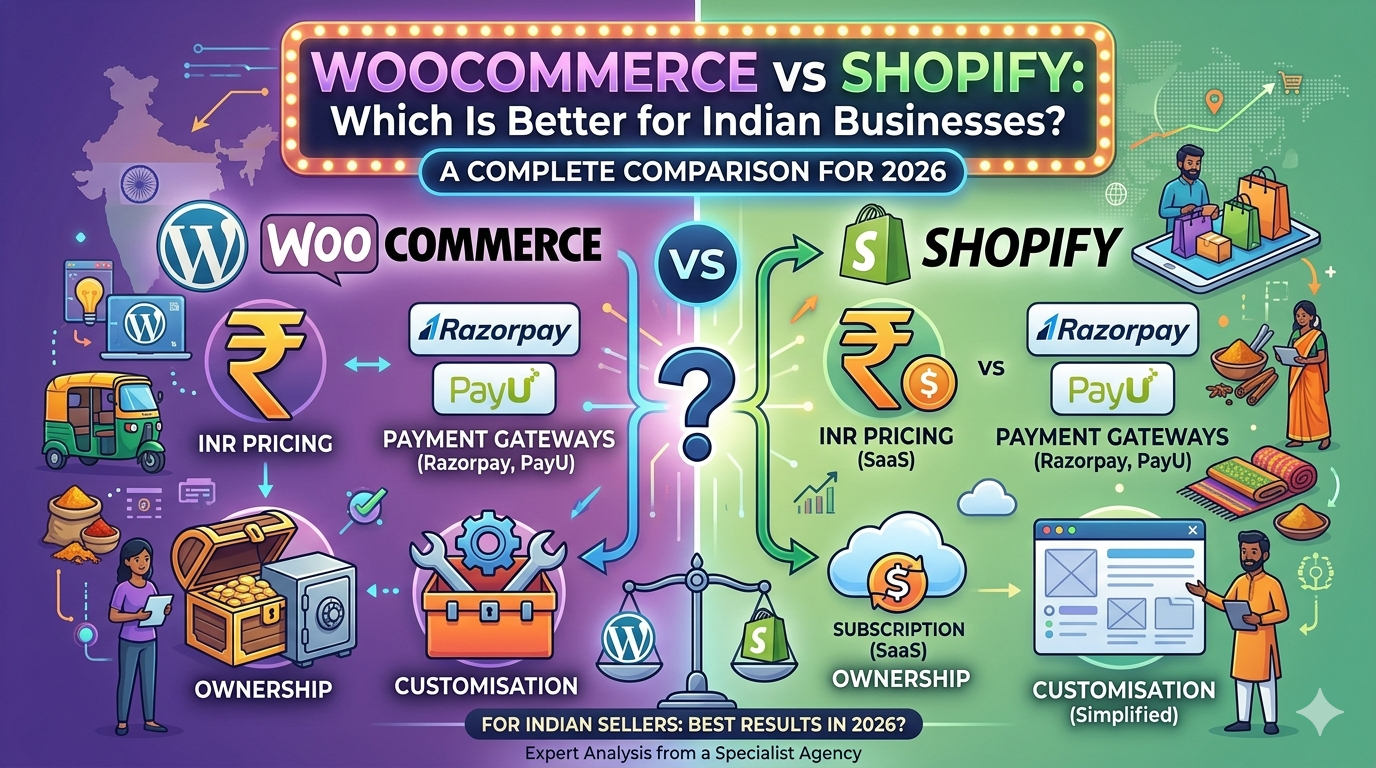
You’re starting an online store in India. You’ve heard of both WooCommerce vs Shopify. Both will let you sell products online — but they are fundamentally different platforms, and the right choice depends on your business model, your budget, and how much control you want over your store.
We’ve built WooCommerce stores for clients in India, Australia, Belgium, and the USA. Here is our honest comparison, with specific attention to the factors that matter most for Indian businesses.
The Core Difference
WooCommerce vs Shopify is a free, open-source plugin that adds e-commerce functionality to WordPress. You own the software, you own the data, and you choose your hosting. Shopify is a hosted platform — you pay a monthly subscription and Shopify handles the hosting, security, and infrastructure.
This fundamental difference — ownership vs. subscription — shapes everything else about how the two platforms compare.
WooCommerce vs Shopify: Full Comparison for Indian Businesses
Google’s Core Web Vitals are the three performance metrics that directly affect your search rankings in 2026:
| Factor | WooCommerce | Shopify |
|---|---|---|
| Platform Type | Self-hosted, open-source | Hosted SaaS platform |
| Base Cost | Free (hosting ₹500–₹3,000/month) | ₹1,994–₹7,447/month (Basic–Advanced) |
| Transaction Fees | None (pay gateway fees only) | 0.5–2% extra if not using Shopify Payments |
| Razorpay Integration | Yes — native WooCommerce plugin, free | Yes — via Shopify’s app store |
| PayU / Paytm | Yes — free plugins available | Yes — third-party app, may have fees |
| GST Invoicing | Yes — via free WooCommerce GST plugins | Requires third-party apps (often paid) |
| Customisation | Unlimited — full code access | Limited to Shopify’s theme structure |
| Data Ownership | Complete — your server, your database | Shopify owns the infrastructure |
| SEO Control | Full — URL structure, schema, all metadata | Limited — some URL structures fixed |
| Multi-Currency (₹ + $) | Yes — WPML + WooCommerce Multilingual | Yes — built-in (Shopify Markets) |
| App Ecosystem | 50,000+ WordPress plugins | 8,000+ Shopify apps (many paid) |
| Mobile App | Via WooCommerce mobile app (limited) | Full Shopify mobile admin app |
| Support | Community + agency support | 24/7 Shopify support included |
| Exit / Migration | Full data portability | Harder — proprietary data structure |
Why Indian Businesses Often Prefer WooCommerce vs Shopify
1. Zero Transaction Fees
Shopify charges an additional transaction fee (0.5–2% per sale) unless you use Shopify Payments, which is not available in India. This means Indian Shopify stores pay full transaction fees on every order. On a ₹10,00,000/month store on Shopify Basic, you're paying ₹20,000 extra per month just in transaction fees. WooCommerce charges nothing beyond standard payment gateway fees (Razorpay charges 2% per transaction, same as any platform).
2. GST Compliance
WooCommerce vs Shopify has excellent free plugins for Indian GST compliance — including tax calculations, GST invoice generation, and HSN code management. Shopify's built-in tax system is not designed for India's GST structure and typically requires paid third-party apps to handle Indian tax requirements correctly.
3. Full Control Over Your Store
With WooCommerce on WordPress, you own your store completely. Your product data, customer data, order history, and store design live on your own server. You can export everything, switch hosts, or migrate at any time. With Shopify, you're renting space on Shopify's infrastructure — if Shopify changes its pricing, terms, or discontinues a feature you rely on, you have limited options.
4. Better SEO for Long-Term Traffic
WooCommerce vs Shopify on WordPress gives you complete control over URL structure, metadata, schema markup, page speed settings, and internal linking — all critical for SEO. Shopify fixes certain URL patterns (for example, product URLs always include /products/) and has less flexibility for technical SEO. For businesses that want to grow organically on Google, WooCommerce is the stronger long-term platform.
When Shopify Makes More Sense
Shopify is a better choice when:
- You are a non-technical founder who wants to launch quickly without managing hosting, updates, or server security
- You sell internationally and need Shopify’s built-in multi-currency and international markets features
- You need a dedicated mobile admin app for managing orders on the go
- Your store is dropshipping-focused — Shopify’s app ecosystem for dropshipping is better developed
Our Recommendation for Indian Businesses
For most Indian businesses building a professional online store — whether selling fashion, home goods, health products, or B2B items — WooCommerce on WordPress is the better long-term platform. The combination of zero transaction fees, full GST compliance, better SEO control, and complete data ownership consistently outperforms Shopify for Indian market conditions.
The most common objection is setup complexity. A WooCommerce store does require more initial configuration than Shopify. But once it’s set up correctly by a specialist, it’s just as easy to manage day-to-day — and significantly more cost-effective over a 3–5 year horizon.
- A WooCommerce store with Razorpay, GST invoicing, and a custom Elementor design typically costs ₹80,000–₹2,00,000 to build and ₹1,000–₹3,000/month to host — with no transaction fees and no subscription lock-in.
We Build WooCommerce Stores That Sell
Every WooCommerce store we build includes Razorpay integration, GST compliance setup, Elementor Pro design, and training so your team can manage it independently.